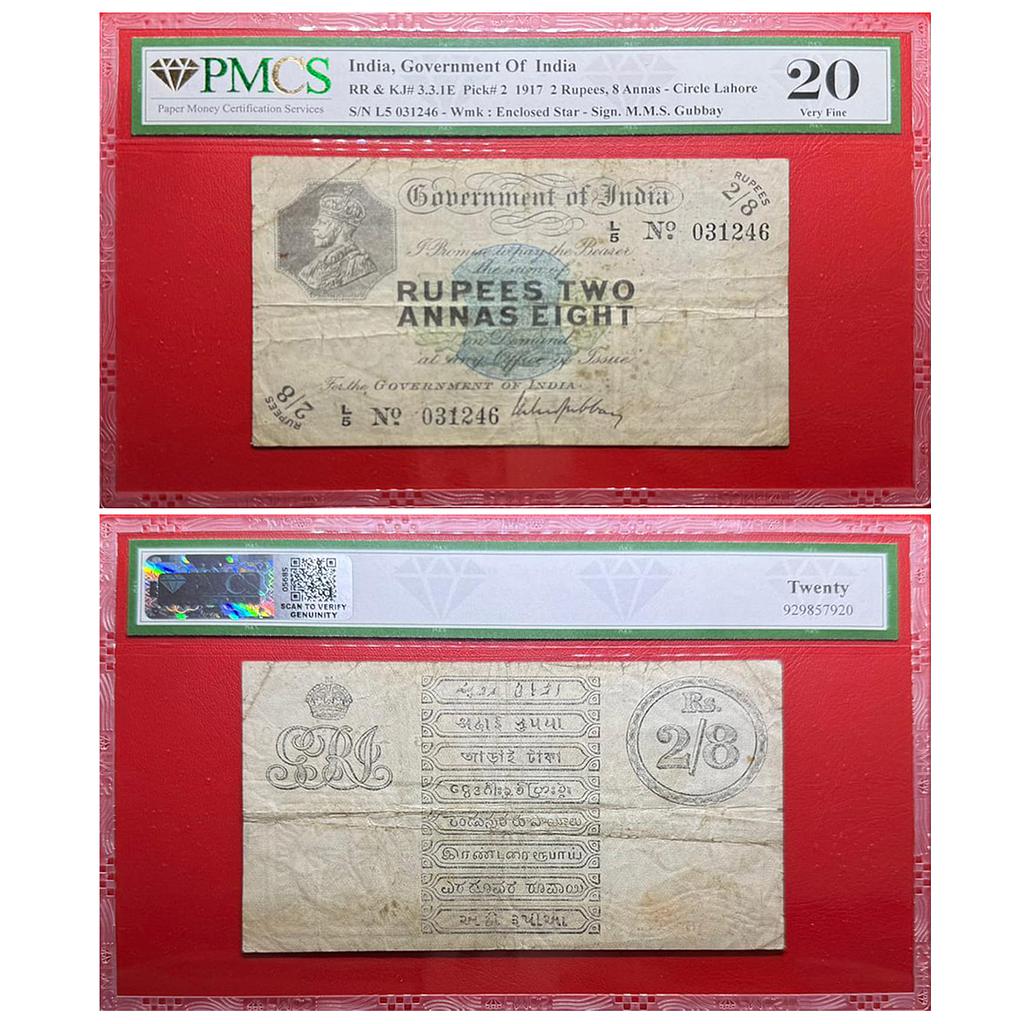
Lot 360
British India King George V Lahore Circle Signed by M.M.S. Gubbay L Prefix Serial no L5 031246 Watermark Enclosed Star 2 Rupees 8 Annas Graded by PMCS as 20 Very Fine
Auction # 30 Lucknow (Online)
- Estimated Price (INR)
- 350000 - 450000
-
Bidding Will Start Soon!
- Catalog Reference #
- KJ & RR # 3.3.1E, Pick # 2
- Metal Composition
- Paper
- Lot Grade/Condition
- Graded by PMCS as 20 Very Fine
- Denomination
- 2 Rupees 8 Annas
- Calendar/Year
- 1910-1936 AD
British India, King George V (1910-1936 AD), 2 Rupees 8 Annas, Lahore Circle, Signed by M.M.S. Gubbay, L Prefix, Serial no.: L5 031246, Watermark Enclosed Star, The 2 Rupees 8 Annas note, equivalent to ₹2½ or 40 annas, was introduced by the Government of British India in 1918 during the First World War. Rising silver prices and widespread hoarding had caused an acute shortage of silver for minting rupee coins. To conserve the metal, the Government issued the ₹1 note in November 1917, followed by this unusual denomination on 2 January 1918, . As ₹5 was then the lowest commonly circulating banknote, ₹2½—exactly half of ₹5—was intended as a convenient intermediate value between the familiar ₹1 coin and ₹5 note, encouraging the public to accept paper money for everyday transactions Bearing the portrait of King George V, printed in England by Thomas De La Rue, and carrying the signature of M. M. S. Gubbay, this was one of British India’s earliest small-denomination notes and remains the only regular Indian banknote issued with a face value of ₹2½. Produced in relatively limited quantities and withdrawn on 1 January 1926 on cost-benefit grounds, it is now regarded as one of the key types of twentieth-century British Indian paper money, despite its modest original face value, The present specimen is particularly desirable as a Lahore Circle issue, identified by the letter “L” in its serial-number prefix, indicating that it was issued through the Lahore currency office in present-day Pakistan. As surviving examples are typically encountered in heavily circulated condition, this specimen is especially appealing for the type, displaying fresh paper, a pleasing overall appearance and excellent eye-appeal. An exceptional example of this scarce and historically significant wartime issue, presenting an important acquisition opportunity for the specialist collector of Indian paper money, KJ & RR # 3.3.1E, Pick # 2, Graded by PMCS as 20 Very Fine, extremely rare.